
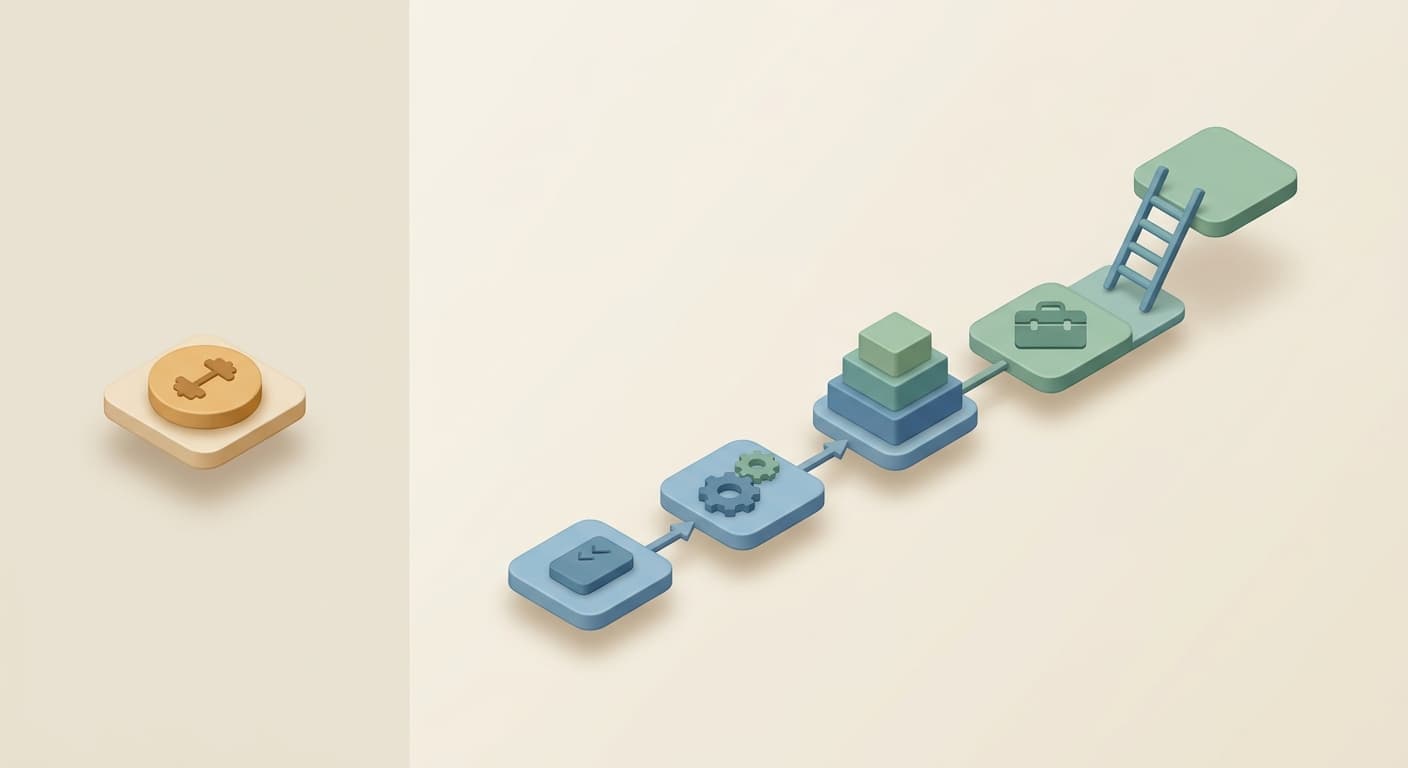
The exercise trap
When you feel scattered, it is tempting to look for a single exercise that will fix it.
A journaling prompt, a breathing technique, a morning routine template, a new note taking method. Something clean, self contained, and easy to try once.
Sometimes that works briefly.
The problem is not that exercises are useless. The problem is that most of life does not repeat in the neat way an exercise does. Energy, calendars, relationships, and responsibilities change. An exercise can work in the situation where you learned it, then quietly fail when the context shifts.
Skills and processes survive the shift.
A skill is a capability you can apply in many situations. A process is a repeatable way to move from a messy starting point to a better outcome. Exercises can help build skills and processes, but they are not the end goal.
If you want durable mental clarity, the better question is not, What exercise should I do today?
It is, What skill am I building, and what process will still work on an average Tuesday?
Skills and processes
An exercise is usually a script: do these steps, in this order, for this amount of time, and you will feel better.
A skill is a set of levers you can pull. You adjust force, timing, and direction depending on the situation.
A process is the container that makes the skill usable. It says when you notice you need it, what you do first, how you decide what matters, and how you close the loop.
In short:
- An exercise is something you do.
- A skill is something you can do.
- A process is how you reliably do it again.
In daily life, clarity depends on repeatability, not novelty.
Why exercises fail to transfer
Transfer means what you learn in one situation carries over to another.
Many mental clarity tools assume transfer is automatic. It is not. Transfer breaks for three common reasons.
First, the cue is missing. In an exercise context the cue is obvious, you opened the app or set aside time. In daily life the cue is ambiguous, you just feel foggy or irritated. If your practice does not include noticing and naming the moment, you will not reach for it.
Second, the load is different. Exercises are learned with low complexity. Real life adds interruptions, social pressure, time limits, and emotion. Skills hold up under load because they are adaptable. Scripts often do not.
Third, the feedback loop is weak. Doing an exercise and feeling a little better does not tell you when to use it next or whether you used it well. Skills improve through feedback. Processes create clearer feedback by making outcomes observable.
A useful mental model: clarity is not a mood you summon. It is a coordination problem you solve repeatedly across changing conditions.
What practice changes
To keep this practical, here is what practice trains in people.
Perception. You notice earlier and label more accurately. You start to detect patterns, for example confusing urgency with importance, or avoiding something because of uncertainty.
Selection. You choose a response from a small set of options. This is where clarity lives. Being clear is often the ability to pick one next step without reopening the whole decision.
Regulation. You stay with discomfort long enough to execute the response. This is not about being calm all the time, it is about keeping enough stability to think and act.
A process ties those three together. It gives a reliable sequence: notice, name, choose, act, review. With repetition, initiating the sequence becomes easier. It may start to feel like a change in character, when really you have built a reliable loop.
Sports training example
Training research highlights the difference between isolated activity and targeted skill practice.
One trial with young soccer players found skill based training produced larger improvements than a more variable game format over several weeks. The authors suggest the skill based format allowed more intense, focused repetitions, which supported stronger adaptation.
This is not a claim that games are bad. It is a reminder that targeted practice can outperform a single broad activity, especially when the goal is a specific capability.
If your aim is better prioritization under pressure, you will usually get there faster by training the prioritization skill inside a repeatable process, rather than hoping a weekly planning session will generalize to every stressful moment.
Strength training example
Strength training makes a similar point in another way.
Some trials show multi joint resistance training and single joint training produce similar gains in untrained people over short periods. In practice, coaches often prefer compound movements because they deliver more training effect per unit time and practice coordination, not just isolated output.
Translate that to mental clarity, and the lesson is, processes that integrate multiple elements often beat isolated exercises, because they better match the complexity of real tasks. Clear thinking is rarely one muscle. It is coordination across attention, emotion, memory, and decision making.
Make an exercise a skill
If you like an exercise, keep it. Do not stop there. Ask three questions.
What is the smallest skill inside the exercise? For example, a breathing exercise often trains the ability to shift attention on purpose and to downshift arousal when it spikes.
Where else do I need that skill? Not only on a mat, but when reading a tense email, when the calendar collapses, or before saying something sharp in a meeting.
How will I know I used it well? Not, I did it for ten minutes. Instead, I noticed the spike early, I slowed my response, I chose the next step, and I returned to the task.
That is how an exercise becomes transferable.
Processes for busy days
Processes fail when they require ideal conditions. Build three versions: full, small, and emergency.
The full version is what you do when you have time. It can include journaling, review, and planning.
The small version is what you do when you are busy but not on fire. It should take two to five minutes.
The emergency version is what you do when things are actively messy. It should take thirty to ninety seconds, and still move you forward.
A simple process you can run in any mode:
- Name the situation in one sentence, without interpreting it.
- Name the main constraint, for example time, energy, uncertainty, or social risk.
- Choose the next smallest action that reduces uncertainty, not a perfect plan.
- Close the loop by deciding when you will revisit or what result you expect.
If you use Mendro for reflection, one neutral way to use it is to capture the one sentence situation, the constraint, and the next smallest action, so you can return without reloading the whole context later.
When it does not fit
Some exercises are exactly what you need, especially for immediate regulation. If you are panicking, a single grounding exercise can be the right tool.
Also, skills and processes still require practice. A process is a structure for repetition, not magic.
Finally, direct evidence comparing isolated exercises and broader processes for mental clarity is limited. Most research comes from other domains, like sports or clinical training. The value here is the mechanism and the transfer principle, not a claim that one study settles the question for all behavior.
Redefine progress
If you want more stable change, measure a different thing.
Not, Did I do the exercise today? But, Did I notice sooner, choose better, and recover faster?
Skills make that possible. Processes make it repeatable. Exercises are useful, mostly as training reps inside a larger system.
That is what lasts.