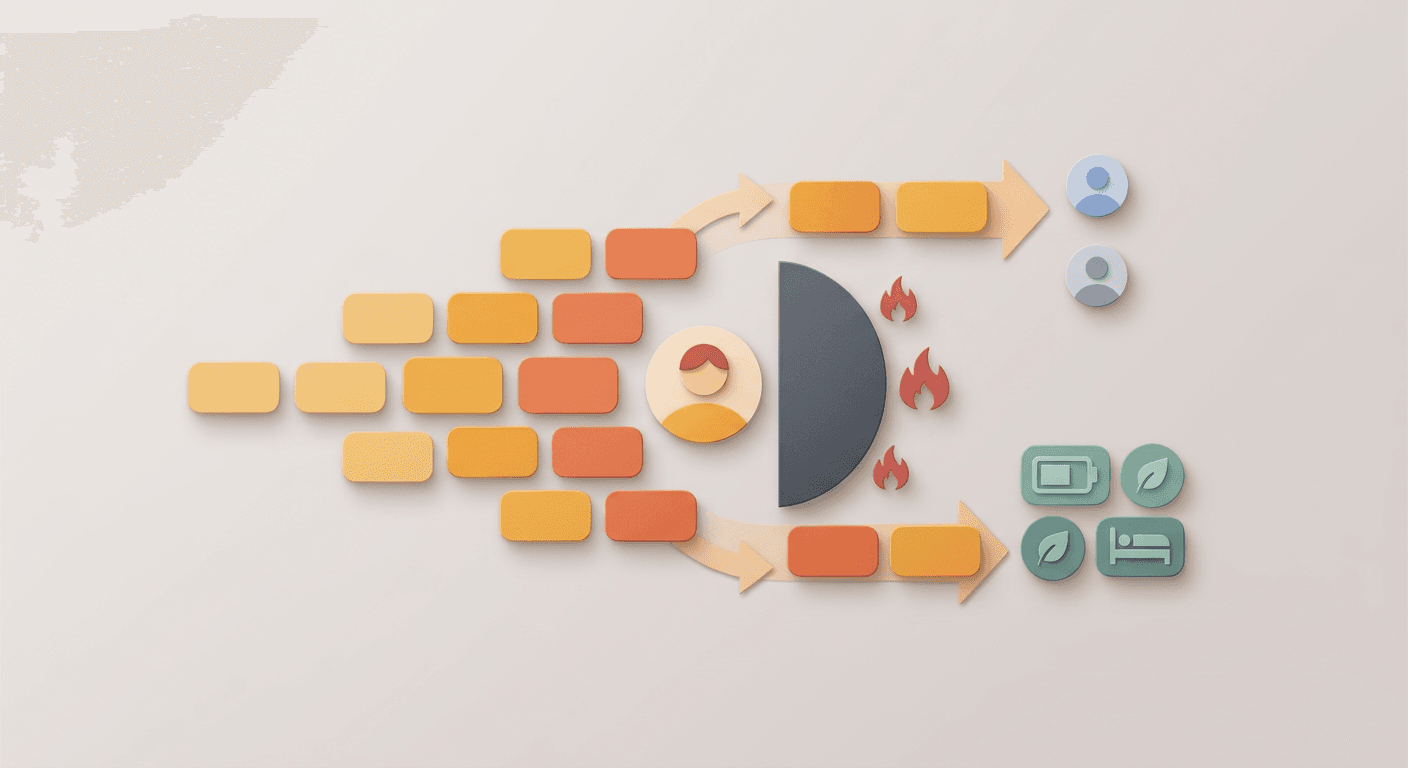


How it spreads
Financial insecurity rarely appears as a single crisis. It often lives in the background: rent that might rise, a credit card balance that never resets, a medical bill you worry about, or a job that feels shaky. That ongoing uncertainty makes the experience more than a money problem. When basic needs feel unpredictable, the brain treats the situation as a continuing threat, and that changes feelings, thinking, and bodily priorities.
A useful frame is this: financial insecurity is a sustained load on attention and physiology. Over time, that load transforms into a well-being problem, often before any single catastrophic event occurs.
What research shows
Studies consistently link financial insecurity with worse psychological well-being. For example, a systematic review examining people with terminal illness found that most psychological analyses reported negative associations between financial strain and measures of emotional well-being and quality of life. Research on wider economic crises shows similar patterns, with increased depression, anxiety, and in some cases higher suicide risk during periods of widespread job loss and instability.
The pattern is consistent but not uniform. Different studies measure financial insecurity differently, and social supports, benefits, and local conditions shape how strongly money problems affect health. Still, the overall direction is clear: financial instability raises the likelihood of distress.
Chronic stress
Acute stress spikes and then resolves. Chronic stress keeps activating without enough recovery time. Financial insecurity is a strong recipe for chronic stress because it is recurring, hard to fully control, and frequently ambiguous.
When you perceive ongoing threat, the brain triggers hormonal and nervous system responses to mobilize energy and sharpen attention. That response is useful in the short term. Repeated activation leads to wear and tear across systems that regulate mood, sleep, inflammation, and cardiovascular function. This physiological cascade helps explain why financial worry can feel like it is present in many parts of life, not just in your head.
Cognitive bandwidth
A common reaction is to treat financial strain as a personal failing, but a clearer view is that scarcity taxes cognitive bandwidth. Bandwidth means the mental capacity for attention, working memory, and self-control. When money feels scarce, some of that capacity gets taken up by monitoring balances, calculating trade-offs, anticipating expenses, and replaying worst-case scenarios.
That adaptive prioritization has costs. With less bandwidth available you may feel depleted after routine tasks, postpone paperwork or planning, find small setbacks especially disruptive, and become more distractible or impatient. This reduced mental capacity both increases stress and makes it harder to do the planning and emotion regulation that would normally help.
Decision-making shifts
When bandwidth narrows, decisions tend to favor immediate relief. Attention collapses on the most urgent threats, a process sometimes called tunneling. Tunneling produces behaviors that can seem short-sighted from the outside.
Under pressure people may pay the loudest bill first rather than the most cost-effective one, choose quick comforts because their system is exhausted, avoid calls or mail to dodge new uncertainty, or take high-cost options that remove immediate worry. These moves make sense in the moment. They also interact with structural factors, because environments that keep creating uncertainty make it hard for "good" decisions to stick.
Recognizing this distinction matters. The behavior layer is what people do under pressure. The structural layer is the context that keeps recreating pressure. Fixing outcomes often requires addressing both.
Mental then physical
The earliest effects of financial insecurity often show up in mood, sleep, and relationships: irritability, rumination, shame, conflict, and a reduced ability to enjoy life. Over longer periods, chronic stress can disrupt sleep, increase inflammation, and raise cardiovascular risk. Bandwidth depletion also makes maintaining healthy routines harder, not because people do not care, but because those routines cost mental and practical effort.
Mental and physical health feed each other. Poor sleep amplifies anxiety, anxiety worsens sleep, and pain increases worry. Those feedback loops help explain how financial stress can slowly erode overall health.
Limits and gaps
We can be confident about the general pattern, but we should also be clear about limits. Many studies focus on particular populations or use different measures of financial insecurity, such as difficulty paying bills, debt, income volatility, or subjective worry. Those measures are related but not identical, and context matters.
Not every study finds a strong association. Social supports, baseline health, and local safety nets can moderate the impact. The details vary, but the basic mechanisms of threat, stress activation, bandwidth loss, and decision shift appear across many settings.
What helps (and how reflection turns insight into action)
If financial insecurity is a stress and bandwidth problem, effective responses reduce load and uncertainty. But there is another layer that often gets missed: you can not change what you can not see clearly, and chronic stress makes clarity harder.
That is where structured self-reflection can be surprisingly practical. Using a self-reflection app like Mendro can help you:
-
Name what’s happening (reduces mental noise).
When worry is vague, it spreads. A quick reflection ("What exactly am I afraid will happen this month?") turns a foggy threat into a concrete list, something your brain can actually work with. -
Translate reflection into one next step (restores agency).
Financial stress often creates paralysis or frantic "tunneling." Mendro-style prompts can guide you to choose one realistic action for today (e.g., "call the billing office," "set a 15-minute budget check," "apply to one job," "ask a friend for a referral") instead of trying to solve everything at once. -
Track patterns so you can intervene earlier.
If you reflect for a few minutes each day, you can start noticing trends: which situations spike stress, which thoughts lead to avoidance, and what helps you recover. That makes coping more strategic and less reactive. -
Protect your capacity by appreciating what is still working.
Financial insecurity can make life feel like it is only problems. Reflection can intentionally widen attention: "What went right today?" "What did I handle well?" "Who supported me?" This is not denial, it is nervous-system balance. Noticing small wins and sources of stability helps counter the brain’s threat-bias and supports resilience.
A simple Mendro reflection you can try tonight
If money stress is high, use a short three-part check-in:
- What’s the loudest money worry in my mind right now?
- What’s one step that would reduce uncertainty by 1%? (one email, one call, one plan, one ask)
- What is one good thing I don’t want to miss today, even if life is hard?
Over time, this kind of reflection does two things at once: it helps you act (reduce uncertainty) and appreciate (keep life from shrinking into threat-only mode).
Reframing your experience
If you are living with financial insecurity, distress is not a sign that you are failing. It often reflects a normal brain and body response to ongoing uncertainty. Financial insecurity raises perceived threat, drives repeated stress activation, consumes cognitive bandwidth, and nudges decisions toward short-term stability. Over time, these shifts reduce quality of life and can affect physical health.
That explanation does not erase the problem, but it changes the frame from blame to understanding. Understanding makes it easier to choose realistic, compassionate steps that reduce uncertainty and protect your well-being. And tools like Mendro can support that shift by helping you reflect on what you’re carrying, choose a next step, and keep sight of the good that still exists alongside the stress.