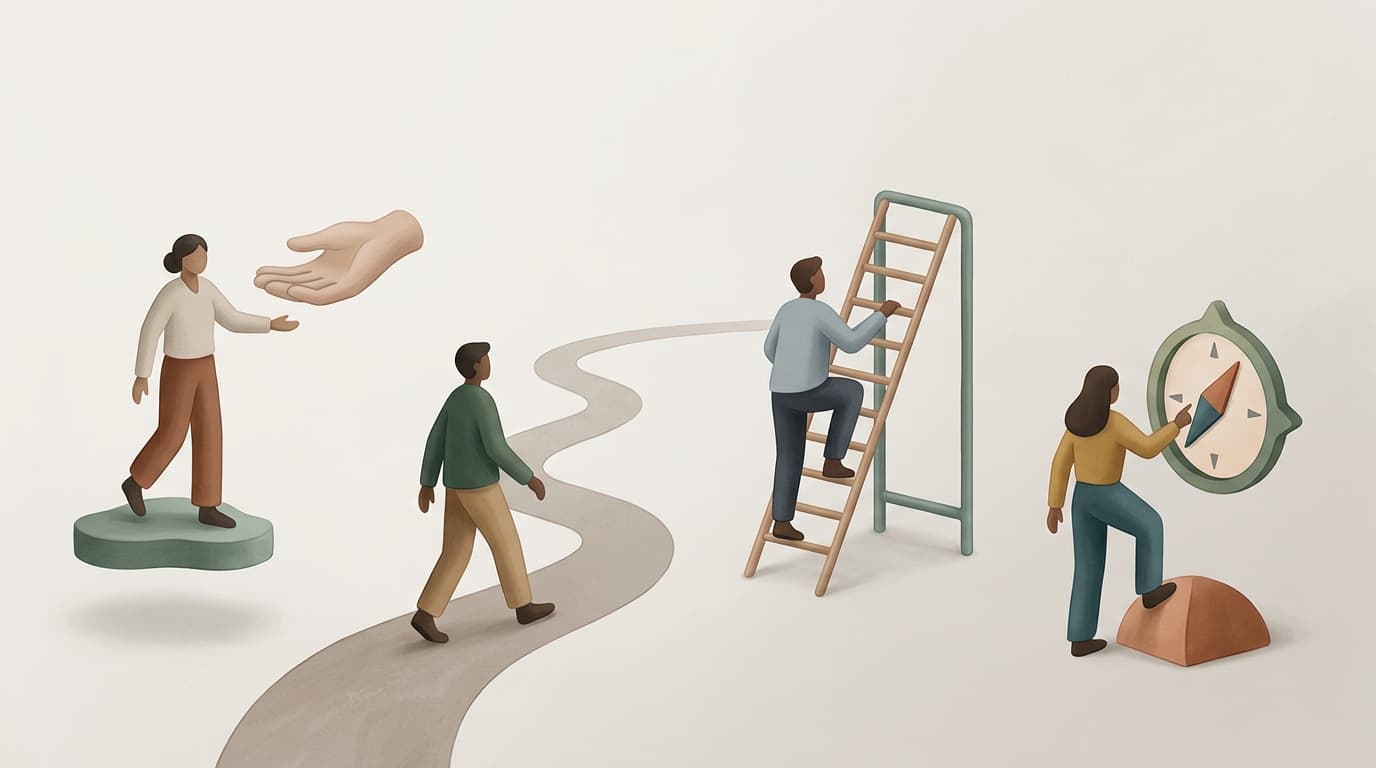


Change vs Transition
A change is factual. You got laid off. You moved cities. The relationship ended. You became a parent.
A transition is psychological. It is the internal reorganization that must happen after the facts change, when old routines and identity no longer fit and new ones are not stable yet.
That gap is where people panic, freeze, or overcorrect. Not because they are weak, but because the mind is doing a difficult job with incomplete information. The INSIGHT framework is a practical way to move through that gap with more clarity and less self-betrayal.
Why transitions destabilize
Most transitions create three kinds of strain at once.
First, they disrupt prediction. Your brain reduces uncertainty because uncertainty costs energy and can imply danger. When the future is unclear, attention narrows, your threat system ramps up, and small decisions feel loaded.
Second, they disrupt identity. Much of your sense of self lives in roles and repetition: partner, employee, caregiver, student, athlete, the person who always knows what to do. When a role ends, you lose a way of knowing who you are.
Third, they disrupt regulation. In stable seasons you regulate emotion partly through structure: familiar people, places, habits, sleep rhythms, and expectations. During a transition the scaffolding disappears. You must regulate with fewer supports.
This is why "just be positive" rarely helps. The problem is not attitude. The problem is that internal systems are trying to rebuild a map while you are still walking. A useful framework does not eliminate uncertainty. It gives you a way to relate to it.
INSIGHT in one sentence
INSIGHT is a reflection process for life transitions that helps you acknowledge what is ending, stabilize yourself in the in-between, make meaning from what changed, and choose small, testable next steps that match your values.
It overlaps with classic transition models that name an ending, a neutral zone, and a new beginning. This version is intended as a notebook process, not a personality test or a rigid stage theory.
One important note, for honesty: "INSIGHT framework" is not a universally standardized model. The label most often appears in coaching and counseling contexts. Here it is offered as a practical scaffold, grounded in known transition patterns.
INSIGHT steps
This version is simple, sequential, and forgiving. Use it as a loop, not a checklist. Reflect, act, review, repeat.
I: Inventory
Transitions feel chaotic because your mind holds many losses and demands as one blurry mass. Inventory turns blur into parts.
Try this prompt: write three short lists: what is ending or loosening, what is staying, what is unknown. Then underline what is emotionally loudest, not what is logically biggest.
Example: considering a career change, "ending" might include status and familiar coworkers, "staying" might include curiosity and fast learning, and "unknown" might be money, identity, and whether you will regret it.
This step reduces cognitive load. You convert background anxiety into explicit objects your mind can handle.
N: Name losses
People often try to skip grief by rebranding it as productivity. That usually backfires. Unacknowledged loss leaks into irritability, numbness, impulsive choices, and harsh self-talk.
Ask: what am I grieving, even if I chose this? What did this chapter give me that I am afraid I will not find again?
If you are in a breakup, you might grieve the person and the future you rehearsed, the version of you that felt chosen, and the routines that regulated you.
Grief is not only sadness. It is your attachment system updating expectations, and it needs time and contact with reality to do that update.
S: Stabilize
Most transitions include a neutral zone, a messy middle where the old structure is gone and the new one is not reliable yet. Discomfort in this phase is not proof of a mistake. It is a sign your system is under-supported.
Stabilizing restores basic conditions so you can think. Pick two small stabilizers to follow for two weeks, for example:
- Keep roughly consistent sleep and wake times.
- Move daily in a way you can keep even on bad days.
- Have one conversation a week with someone who steadies you.
- Reduce input when dysregulated: less news, alcohol, or doom-scrolling.
Then ask, what are my early warning signs that I am leaving the window where I can think clearly? When arousal stays too high, decision-making becomes short-term and threat-driven. Stabilization increases the chance your next step will be chosen, not discharged.
I: Integrate
A transition can fracture your timeline. You may start telling stories like, "That was the old me," or "Nothing I did before matters."
Integration asks what carries forward. Ask: what have I handled before that is similar? Which skills, values, or relationships are still assets? If this transition were a chapter in a longer story, what is it trying to teach me?
This is where resilience becomes practical. Resilience involves staying engaged with life, regulating emotion, and making meaning under stress. Meaning-making is not forced positivity, it is building a coherent story that allows action.
Example: leaving a high-status job might become, "I am not starting over. I bring leadership skills into a different environment, and I am learning what cost I will no longer pay."
G: Generate options, then shrink
The mind in the messy middle often oscillates between "I have no options" and "I have infinite options and am failing to choose." Aim for a middle path: generate widely, then narrow gently.
Two passes: first, generate 10 ways forward, including ridiculous ones. Second, shrink to two options that are both reversible enough and aligned with your values.
This protects against false binaries and creates movement without demanding a permanent identity decision right away.
H: Hold experiments lightly
A good next step is often an experiment, not a declaration. Ask: what is the smallest step that would teach me something real? How will I measure whether this fits, beyond mood on day one?
Example: before moving across the country, do a two-week stay, talk to people who live there, or simulate the commute and routine.
Holding lightly does not mean avoiding commitment. It means you stop asking experiments to provide certainty they cannot provide.
T: Take and review
A transition becomes livable when you build a feedback loop: act, learn, adjust. End each week with three questions: what did I do that made me feel more like myself? What drained me in a way that feels informative? What is one thing to repeat next week, and one thing to stop?
This is where reflection turns practical. You are not trying to figure everything out in your head. You are building evidence through lived experience.
Common transitions
You can use the same scaffold in very different situations. The content changes, not the process.
Career change: Inventory status, structure, and identity you might lose, and what values you might regain. Name what feels embarrassing or behind. Stabilize with routines that keep you functional while you learn. Integrate by listing transferable skills. Generate adjacent roles, hold small projects or informational interviews as experiments, then take weekly reviews to update assumptions.
Breakup or divorce: Inventory what ended, what remains, and what is uncertain. Name the future and safety you lost. Stabilize by leaning on steady people and habits that reduce night spirals. Integrate by deciding patterns you want to keep and patterns to end. Generate a picture of a good next life beyond dating, test new routines, and review what grounds you.
Relocation: Inventory what you will miss, what you are escaping, and what you are seeking. Name identities tied to your old place. Stabilize the first month with sleep, food, movement, and people. Integrate by choosing what to preserve from your old life. Generate multiple ways to belong here, test neighborhoods and schedules, then review what makes a place feel like home.
Common misuses
Frameworks can become another way to avoid the real work. Watch for these patterns.
- Using reflection to delay action. If you have journaled for months without new information, you might be regulating anxiety through thinking, not solving the problem.
- Using action to avoid grief. If you constantly optimize your next chapter to avoid quiet evenings, you may be outrunning loss.
- Treating the messy middle as failure. The neutral zone is uncomfortable by design. Expecting clarity too early turns normal turbulence into evidence you are broken.
INSIGHT works best as a loop: reflect, act, review, repeat.
Limits and scope
INSIGHT helps most when the problem is ambiguous, identity-relevant, and emotionally charged. It gives your mind something to do that is not rumination and your body something to do that is not panic.
It does not replace medical or mental health care. If your transition includes persistent insomnia, worsening depression, or panic symptoms, seek additional support. It also does not guarantee the "right" choice. Transitions rarely offer that. What it can do is help you choose the next honest step with fewer self-deceptions.
Start today
If you only do one thing, write this sentence: "This transition is asking me to let go of ____." Then write: "The smallest next step I can take without betraying myself is ____."
That is the INSIGHT posture in miniature: face reality, respect the loss, and make one workable move.
If you use a reflection tool like Mendro, capture your weekly INSIGHT review in one place so you can see what steadies you over time. One entry per week is enough.