

Empathy, in plain terms
Empathy is the capacity to understand what another person is feeling, and to relate to that feeling from the inside, not just as an idea.
This matters because empathy is often mixed up with things that feel similar. Empathy is not the same as agreement. You can empathize with someone and still disagree with their decision. It is not the same as being nice, because empathy can be quiet, firm, or bounded. And it does not require you to absorb another person's distress as if it were yours.
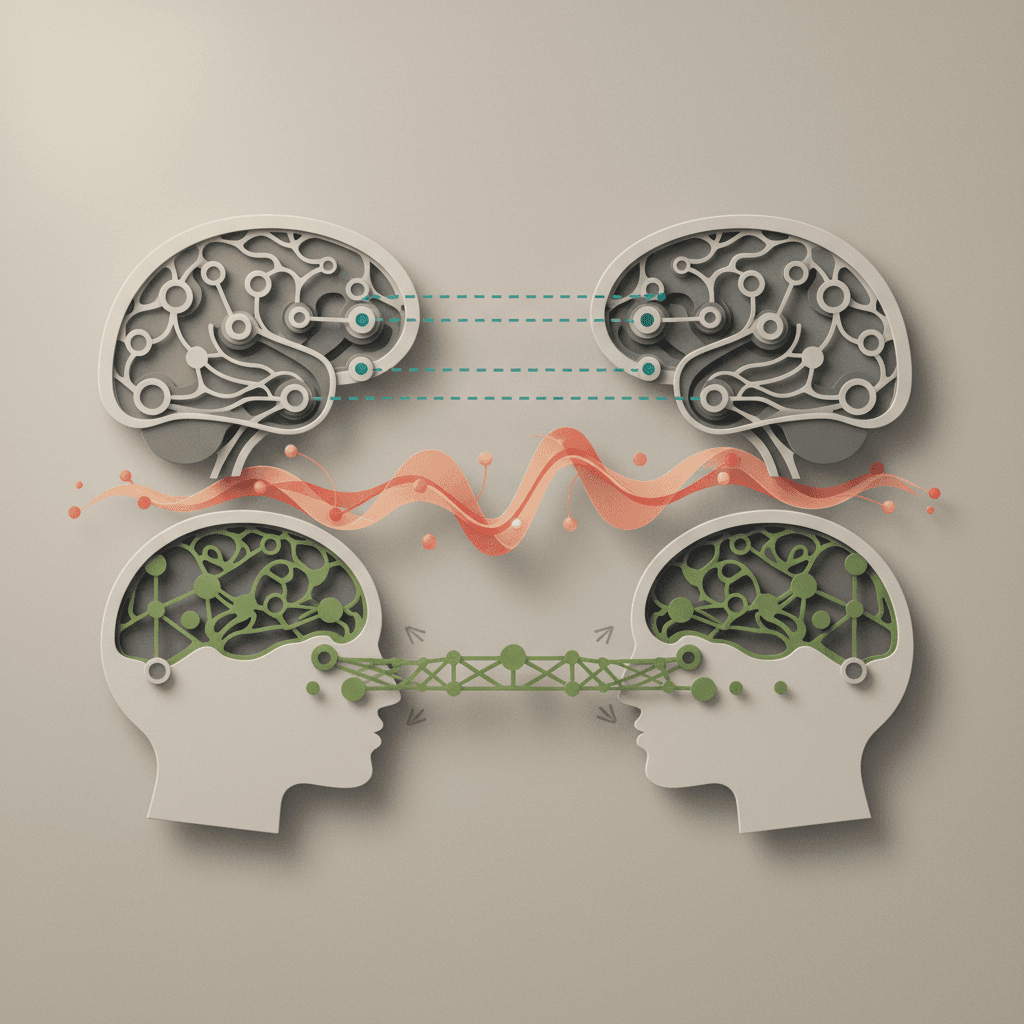
A useful way to think about empathy is as a bridge between inner worlds. It helps you get what an experience is like for someone else, while keeping your own perspective intact.
How empathy works
Empathy is not a single feeling. It is a coordination problem your mind solves in real time. In everyday interaction it usually involves three connected processes that can happen quickly, sometimes below conscious awareness.
First, affective resonance. You pick up emotional signals from tone of voice, facial expression, posture, or what is happening in context. This creates a fast, bodily sense that something matters to the other person.
Second, perspective-taking. You build a rough model of why the person feels that way. You consider their situation, what they care about, and what they might be thinking.
Third, regulation and choice. You manage your own state and decide how to respond. That might mean offering comfort, asking a clarifying question, staying present without speaking, or setting a boundary.
These pieces rely on attention, imagination, and self-regulation. If you are tired or stressed, regulation is harder and empathy becomes more effortful. Empathy is also shaped by familiarity and experience. It is easier to tune into someone whose emotions feel legible to you or whose situation you can imagine.
Main types of empathy
Most practical conversations use two categories that capture the basics: affective empathy and cognitive empathy.
Affective empathy
Affective empathy is the emotional echo you feel in response to another person. When a friend says they were laid off, you might feel a heavy drop in your chest. You not only understand their pain, you feel a version of it.
This kind of empathy creates immediacy and can make someone feel less alone. It becomes a problem when it floods you emotionally, so the conversation shifts to managing your own discomfort instead of supporting the other person.
Cognitive empathy
Cognitive empathy is the ability to understand another person's perspective. It is mentally modeling their thoughts, fears, and values, even if you do not share them.
For example, if a coworker snaps in a meeting, cognitive empathy lets you ask what pressures might explain that reaction. It is especially useful in conflict because it prevents quick judgments from hardening into certainty. Cognitive empathy without care can feel strategic, as if you are using understanding to influence rather than to connect.
Empathy, sympathy, compassion
These words overlap in everyday speech, but they mean different things.
Sympathy is feeling for someone, noticing their pain and expressing concern. It might sound like, "I'm so sorry that happened." Sympathy does not require stepping into the other person's inner world.
Compassion is the motivation to help or relieve suffering. It often uses empathy as input, but it adds a directional push toward care. A compassionate response might be, "That's really hard. What would help right now, a plan or company?"
A quick shorthand:
- Empathy: I understand and can feel with you.
- Sympathy: I feel for you.
- Compassion: I want to support you.
Everyday examples
Empathy rarely looks dramatic. It is usually small, specific, and practical.
Example 1: Naming the feeling Someone says, "I bombed the presentation." A low-empathy response: "You'll do better next time." An empathic response: "That sounds embarrassing. Do you want to talk through what happened or take a break from it?" This reflects the emotion and offers choice, which helps the person feel seen.
Example 2: Staying with the experience Someone says, "My dad's health is getting worse." An empathic response: "That's scary. Are you dealing with a lot of uncertainty right now?" Fixing too quickly can feel like avoidance. Empathy signals that you can stay present.
Example 3: Empathy with a boundary Someone says, "Can you talk tonight? I'm spiraling again." An empathic and bounded response: "I care about you, and I'm not able to talk tonight. I can call tomorrow at 10 a.m., or we can text for ten minutes now." Empathy does not require unlimited availability. It pairs honest care with responsible limits.
Example 4: Empathy in disagreement Someone says, "I think you're being unfair." An empathic response: "Tell me what felt unfair. I want to understand your side before I respond." You are not conceding. You are gathering the other person's internal logic so your next step is more accurate.
Why it matters
Empathy helps relationships because it makes people feel seen in the way they actually experience themselves. When someone feels seen, defensiveness often lowers, nuance returns, repair becomes possible, and conversations become more precise.
That said, empathy is a tool not a cure. It will not, by itself, make people honest, safe, or aligned with your values. It improves understanding and makes productive communication easier, but it does not guarantee agreement or harmony.
What empathy does not cover
Empathy has clear limits. It is not accuracy, because you can empathize and still misunderstand; curiosity is the fix, not confidence. It is not self-erasure, because your own feelings and needs still matter. It is not a substitute for action; sometimes the kindest response is doing something concrete. And it is not infinite; empathy changes with stress, burnout, and available capacity.
If you use a reflection tool like Mendro, empathy can be a helpful lens. Ask, "What might they have been feeling?" and also, "What did I need in that moment?" Both questions can be true at once.
A clearer definition
Empathy is the skill of contacting another person's inner experience, emotionally and/or cognitively, while staying anchored in your own. When it works well, it creates understanding without collapse, closeness without fusion, and care without losing yourself.