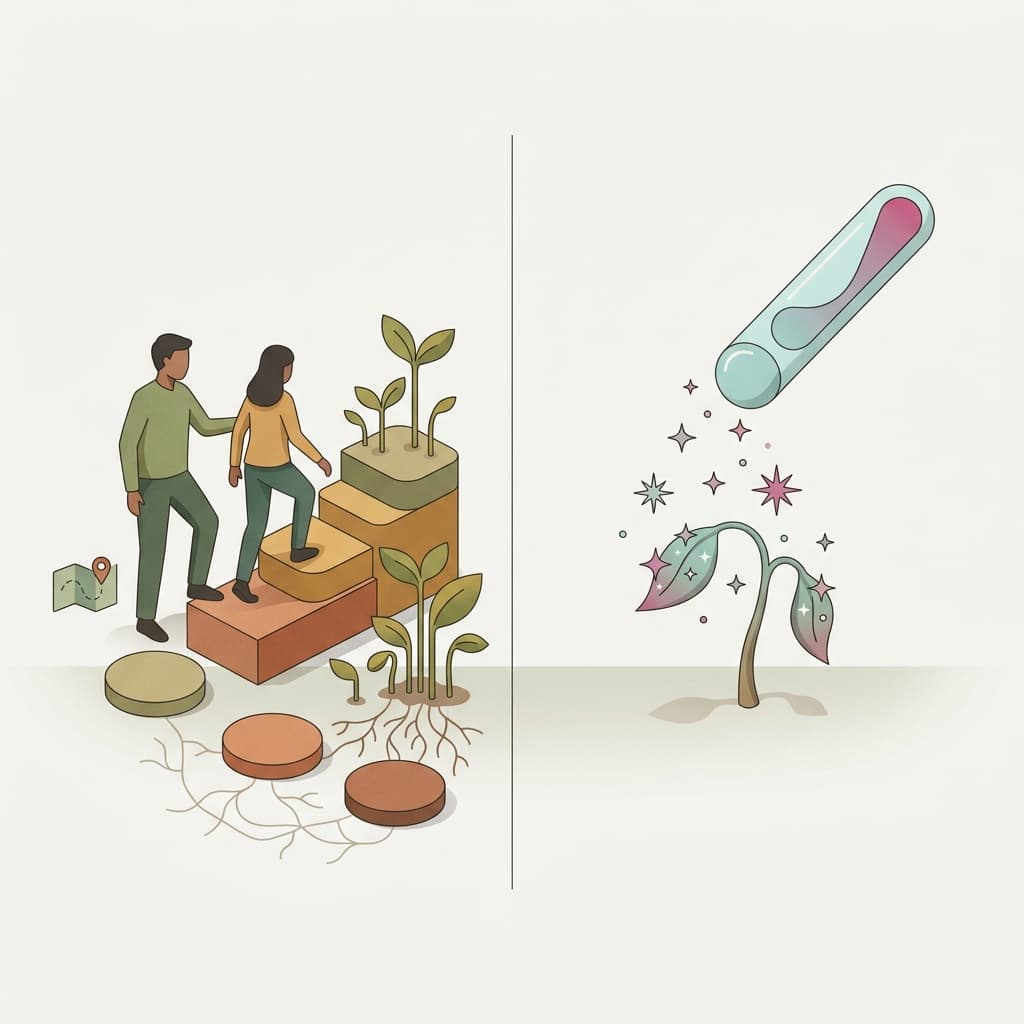


PERMA is not a mood tracker
Most people start thinking about well-being by asking, "Am I happy?"
PERMA begins with a different assumption. Well-being is real, but it is not a single thing. It is more like a meal made of distinct ingredients. You can improve one ingredient without magically fixing all the others, and you can also have one ingredient missing and feel that something is off.
That is the practical usefulness of the PERMA model. It gives you five separate places to look when your overall sense of life feels confusing.
What PERMA is
PERMA is a framework introduced by psychologist Martin Seligman. The letters stand for Positive Emotion, Engagement, Relationships, Meaning, and Accomplishment.
Seligman proposed that each element counts because it meets three conditions. Each one:
- contributes to well-being,
- is something people pursue for its own sake, and
- can be defined and measured somewhat independently from the others.
That framing keeps the model from collapsing into a single vague idea. Meaning is not just another word for relationships, and accomplishment is not only a side effect of engagement. They can overlap in life, but conceptually they remain distinct.
Why five elements help
PERMA mirrors how motivation and experience are organized. In everyday life, your mind runs several "value systems" at once.
Some systems are about immediate feelings and safety, such as comfort, pleasure, relief, and calm. Some are about absorption and attention, for example getting pulled into a task until time disappears. Some are about social belonging and support. Some are about coherence and purpose, the feeling that your life connects to something larger. Some are about competence, progress, and the satisfaction of finishing.
When you only ask, "Am I happy," you flatten these systems into one number. When you separate them, you can spot useful mismatches, such as:
- feeling proud of progress but emotionally flat,
- feeling close to people but unchallenged and bored,
- feeling busy but not meaningfully engaged.
PERMA is a practical map. It does not claim to explain every detail of personality, culture, trauma, or ethics. Its strength is that it makes reflection more diagnostic without becoming clinical.
Positive Emotion
Positive Emotion is the felt experience of pleasant emotions, like joy, gratitude, hope, serenity, amusement, or simple contentment.
PERMA does not say positive emotion is the only goal. It says it is one legitimate element of well-being, worth noticing on its own, even when other areas do not change.
Real-life example: You start a five-minute "good things" ritual at the end of the day. Not a forced gratitude list, just three moments you genuinely enjoyed: the first sip of coffee, a funny text, a patch of sunlight on your desk. After a week your circumstances are basically the same, but you notice small positives faster during the day. That shift is Positive Emotion. It is about the texture of experience, not meaning or achievement.
Where this helps, and where it does not: positive emotion can be increased through attention and interpretation, but it can also be constrained by depression, chronic stress, grief, and pain. PERMA is a reflection tool, not a promise that mood is always changeable.
Engagement
Engagement is deep involvement. It is the sense of being absorbed in an activity where your attention is fully recruited. Many descriptions connect this with "flow," the state where challenge and skill are well matched and self-consciousness quiets down.
Engagement is not the same as pleasure. It can be effortful or even frustrating in the moment. The marker is absorption.
Real-life example: You plan to tidy your workspace for ten minutes, then you open a design project and start adjusting details. Suddenly it is an hour later. You are not relaxing, but you feel mentally clean afterward, as if your mind was used the way it wants to be used. That is Engagement.
A useful reflection question: what activities reliably make time disappear for you? The answer often predicts engagement better than "what do I like?"
Relationships
Relationships in PERMA refers to supportive, positive connections with other people. It includes feeling cared for, being able to be yourself, having people you can rely on, and also being that person for someone else.
Humans regulate emotion socially. A calm conversation can downshift stress. Feeling seen can reduce rumination. Shared laughter can change the physiological tone of a day. Relationships are not an accessory, they are part of how the nervous system returns to baseline.
Real-life example: You have a rough week, and instead of powering through you call a friend who knows how to listen without turning it into advice. You hang up feeling more capable, even though your problems are not solved. Nothing was achieved, nothing meaningful was discovered, but your internal load dropped. That is the relationships element at work.
A limitation to name: relationships can also be a source of stress, conflict, and harm. PERMA points to the contribution of positive connection, not to the idea that every relationship is good for you.
Meaning
Meaning is the sense that your life connects to something larger than yourself. That something can be family, faith, craft, service, community, justice, learning, or building something that outlasts you.
Meaning changes how effort feels. When meaning is present, hard things can feel chosen rather than forced. When meaning is absent, even easy things can feel empty.
Real-life example: You volunteer twice a month helping new immigrants practice conversational English. It is not always fun, and you do not get a clear "win" each session. But you leave with a steady feeling of, "This matters." That steadiness is Meaning.
A useful distinction: meaning is not the same as happiness. People can feel meaningful sadness at a funeral, or meaningful stress when caring for a loved one.
Accomplishment
Accomplishment is progress and achievement, including mastery, finishing, and hitting goals. Importantly, it includes achievements people pursue for their own sake, not only because they lead to money, praise, or status.
Underlying accomplishment is competence. When you set a goal, practice, and see improvement, your brain updates its prediction of what you can do. That tends to increase confidence and willingness to take on challenges.
Real-life example: You decide to run a 5K without stopping. You follow a simple plan, track your runs, and after six weeks you do it. The day you complete it you feel a particular satisfaction that is different from pleasure and different from meaning. It is the satisfaction of "I did what I said I would do." That is Accomplishment.
A common trap: accomplishment without the other elements can feel brittle, turning into constant striving with no enjoyment, no relationships, and no purpose. PERMA helps you see that imbalance earlier.
Using PERMA
PERMA is most helpful when you use it as a lens, not a scorecard.
Try this once a week: Think of one recent day, then ask which element was most present and which was most missing. Do not force all five. Just name what is obvious.
Then ask one gentle follow-up: what is the smallest realistic change that would add a bit more of the missing element next week?
Small change ideas that match the model:
- Positive Emotion: one pleasant ritual you can actually repeat.
- Engagement: one hour blocked for an absorbing activity with notifications off.
- Relationships: one reach-out that is not transactional.
- Meaning: one action that expresses a value you already hold.
- Accomplishment: one finishable goal with a clear done line.
If you use a reflection tool like Mendro, PERMA can be a neutral set of tags for journaling entries, so patterns become easier to see over time. It also works well on paper.
What PERMA can and cannot tell you
PERMA is a foundational model, not a diagnosis and not a promise.
It can help you notice which kind of well-being you are low on, instead of assuming you are "just unhappy." It can help you design small experiments that target the right lever. It can provide clearer language for talking about well-being in coaching, teams, or families.
It cannot explain every cause of suffering or flourishing. It cannot replace clinical care for depression, anxiety disorders, trauma, or addiction. It will not decide your values for you.
Keep that boundary clear and PERMA remains useful: a simple, multidimensional way to reflect on what makes life feel like it is going well, and what might be missing when it is not.