
The DMN in plain language
The default mode network, or DMN, is a set of brain regions that becomes more active when your attention turns inward. You often notice it when your mind drifts during a shower, a walk, or while waiting at a red light. That inward focus is not an absence of thinking. It is a different kind of work.
In everyday terms, the DMN supports:
- mind-wandering
- self-referential thinking, meaning thought about you, your past, and your choices
- remembering personal experiences
- imagining future scenes
- understanding other people and relationships
A helpful way to think about it is this: the DMN is not a "do nothing" network. It is a "work on the inside" network.
Where the DMN lives
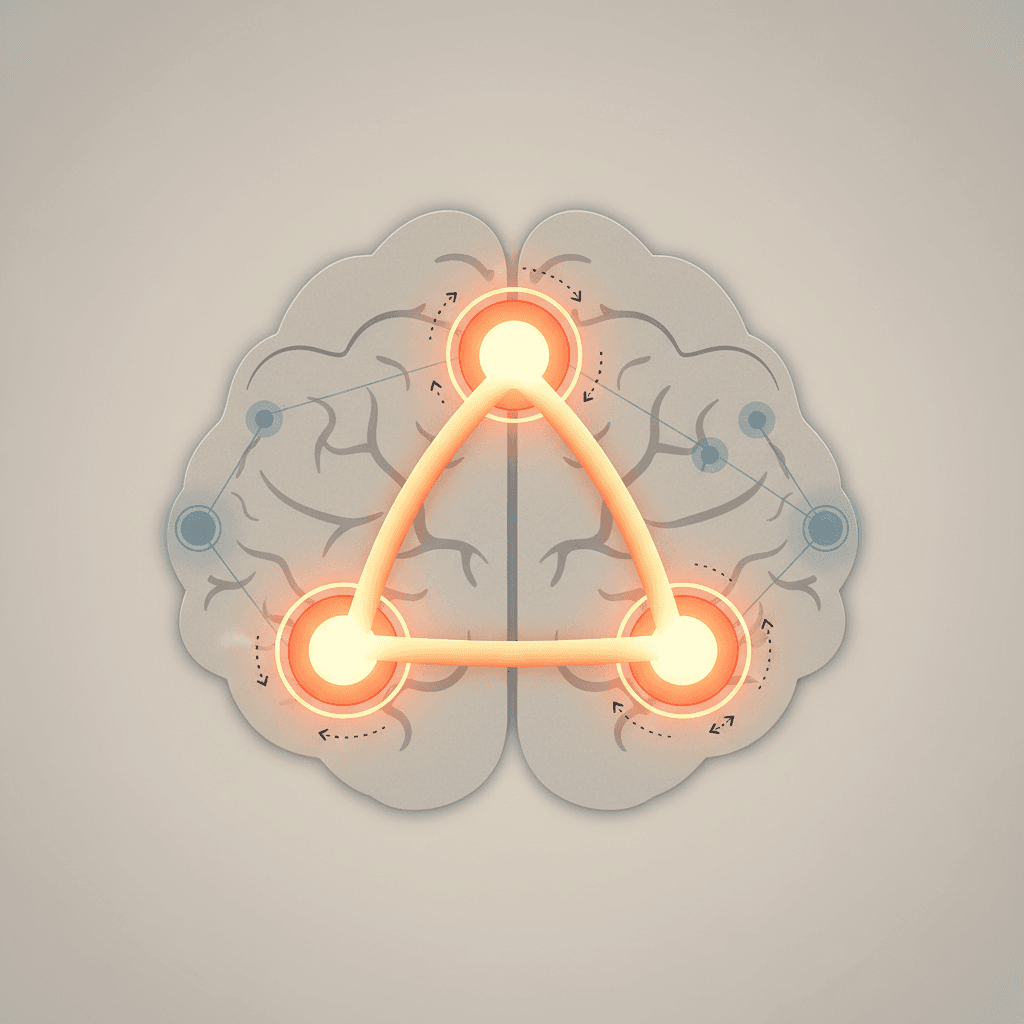
The DMN is not one spot in the brain. It is a pattern of coordinated activity across several regions that tend to activate together, especially in resting-state brain imaging. Common hubs include:
- medial prefrontal cortex, linked to self-evaluation and personal relevance
- posterior cingulate cortex and precuneus, central for integrating internal information
- lateral parietal regions, including the angular gyrus, involved in combining concepts and memory
- medial temporal lobe structures, such as the hippocampus, which support episodic memory and scene construction
You do not need to memorize the anatomy to get the idea. The important point is that the DMN links memory systems with systems that track self and meaning.
How it works
A simple model is two broad attention modes the brain can shift between. One mode prioritizes the outside world. It is active when you read closely, drive in heavy traffic, play a fast sport, or do a demanding work task.
The other mode prioritizes the inside world. It is active when you let your mind roam, replay a conversation, imagine how tomorrow might go, or think about who you want to be.
Early research found a consistent pattern. During many externally focused tasks, DMN activity drops compared with rest. That does not mean the DMN is useless. It means the brain reallocates resources depending on the demands.
The underlying tradeoff is straightforward. Your brain has limited capacity for high fidelity processing. When the environment demands precision, internal simulation is downregulated. When the environment is safe or predictable, the brain runs internal models, memory retrieval, future planning, social inference, and self-evaluation.
This is why mind-wandering is common during routine tasks. If external demands are low, the brain naturally returns to internally oriented processing.
Reflection vs rumination
People often equate the DMN with overthinking. But reflection and rumination are different processes that can both use the same network.
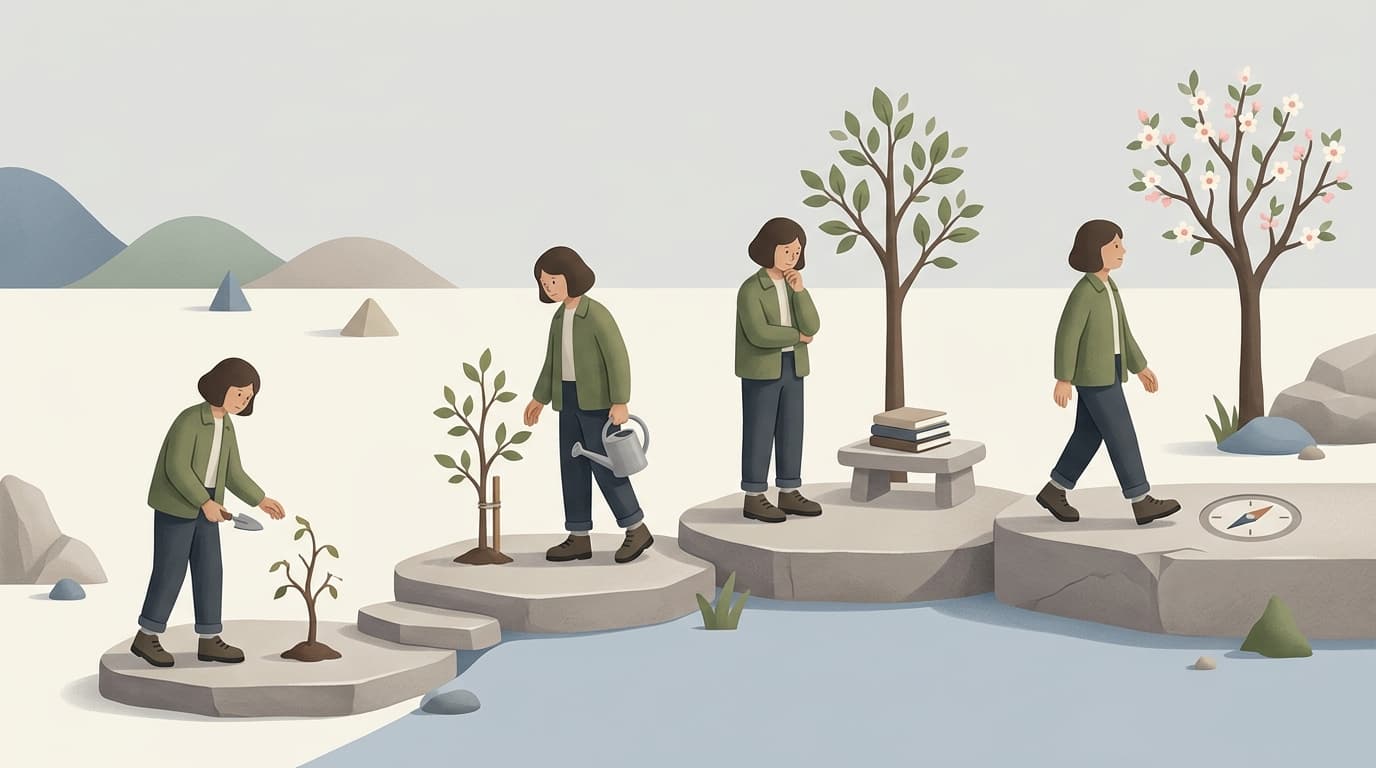
Reflection is exploratory and integrative. It helps you connect experiences, notice patterns, and update your plans or values. Rumination is repetitive and narrowing. It tends to circle the same threat or mistake without leading to new insight.
The DMN enables internal thought in general. Whether that thought becomes helpful reflection or sticky rumination depends on mood, stress, sleep, and whether control systems are guiding attention.
A lived example:
- Reflection: "That meeting went poorly. What did I miss, and what can I try next time?"
- Rumination: "That meeting went poorly. I always mess up. Everyone thinks I am incompetent."
Both are self-related. Only one reliably creates learning.
Why the DMN helps
The DMN is good at offline thinking because it recombines memories and ideas into new scenarios. That recombination supports several practical abilities:
- planning, by simulating outcomes before you act
- identity building, by linking past choices into a coherent story
- social understanding, by modeling other peoples' beliefs and likely reactions
- meaning-making, by interpreting what events say about priorities
This recombination explains why you might get a good idea while doing something boring. It also explains why the same process can produce anxiety. The same simulation engine that helps you plan can generate endless "what if" scenarios when you feel uncertain.
Self-referential thinking
Self-referential thinking uses "me" as the reference point. It includes overt self-talk, and subtler activity like scanning memory for evidence about who you are, replaying your words to estimate how you came across, or deciding whether something counts as progress.
Under the surface, this thinking often tries to reduce uncertainty about social standing, safety, or identity. Because humans are social, a brain that can simulate how others see you and how your actions land has an advantage.
The DMN is one of the main networks implicated in this inward, self-related modeling.
Help and hindrance
The DMN is most helpful when internal thinking does real work, such as integrating memory, clarifying values, or planning concrete next steps. It gets in the way when internal thought becomes untethered from reality checks, repetitive rather than generative, fused with harsh self-judgment, or disconnected from action.
A practical sign is whether the loop changes you. Helpful reflection usually ends with a shift, even a small one, a clearer next step, a softened interpretation, or a repaired story. Unhelpful looping usually ends where it began, only heavier.
What shifts the balance
You can often predict DMN-heavy moments by the situation. The DMN is more likely to dominate when the environment is quiet or predictable, when you are alone, when a task is routine, or when you are tired. It is less likely to dominate when a task is novel, demanding, noisy, or high stakes, and when you are highly engaged with others.
This is not about controlling the DMN directly. It is about recognizing which situations invite inward processing, and what your mind tends to do with that space.
A practical approach
The goal is usually not to stop mind-wandering. The goal is to notice what the wandering is doing.
One small practice is to name the mode you are in, for example: "planning mode," "replaying mode," "comparing mode," "story-building mode," or "worry-simulation mode." Naming creates a little distance and helps you choose whether the thought is useful.
Tools like Mendro can support this kind of reflection by giving you a place to capture recurring themes and patterns. The core skill remains simple: notice the direction of attention, and ask whether the loop creates insight or noise.
What we do not know
Even with extensive study, the DMN has limits in what it can tell us at the individual level. We do not have a one-to-one map from a region lighting up to a specific thought. The DMN includes subsystems that interact with other networks, so it is more accurate to think of it as a family of coordinated processes than a single reflection center.
Much research also relies on group averages. Your brain will match the general pattern but not every detail.
Takeaway
The default mode network is the brain's internally oriented mode, supporting mind-wandering, self-referential thinking, memory, and simulation. That mode is not automatically good or bad. It is a powerful system for making sense of life.
When your attention turns inward, treat mind-wandering as information. Ask what problem your brain is trying to solve, and whether the loop is producing insight or just creating noise.